
Technical Guides
Ground Calcium Carbonate vs. Precipitated Calcium Carbonate: How to Choose for Industrial Applications
GCC and PCC differ in how their particles are produced, but the right choice depends on the grade and application. Compare the evidence to request before selecting calcium carbonate for coatings, polymers, paper, adhesives or sealants.
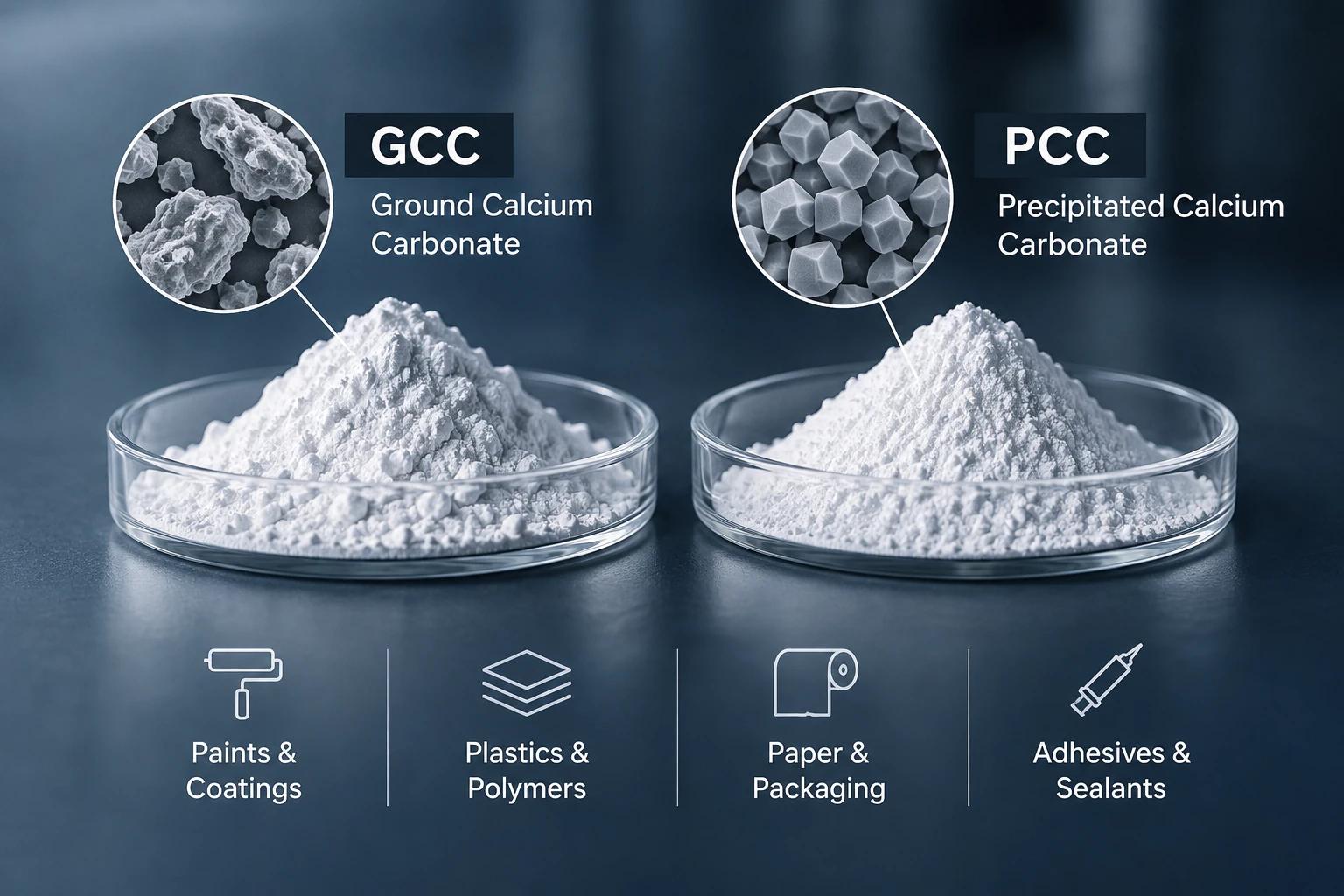
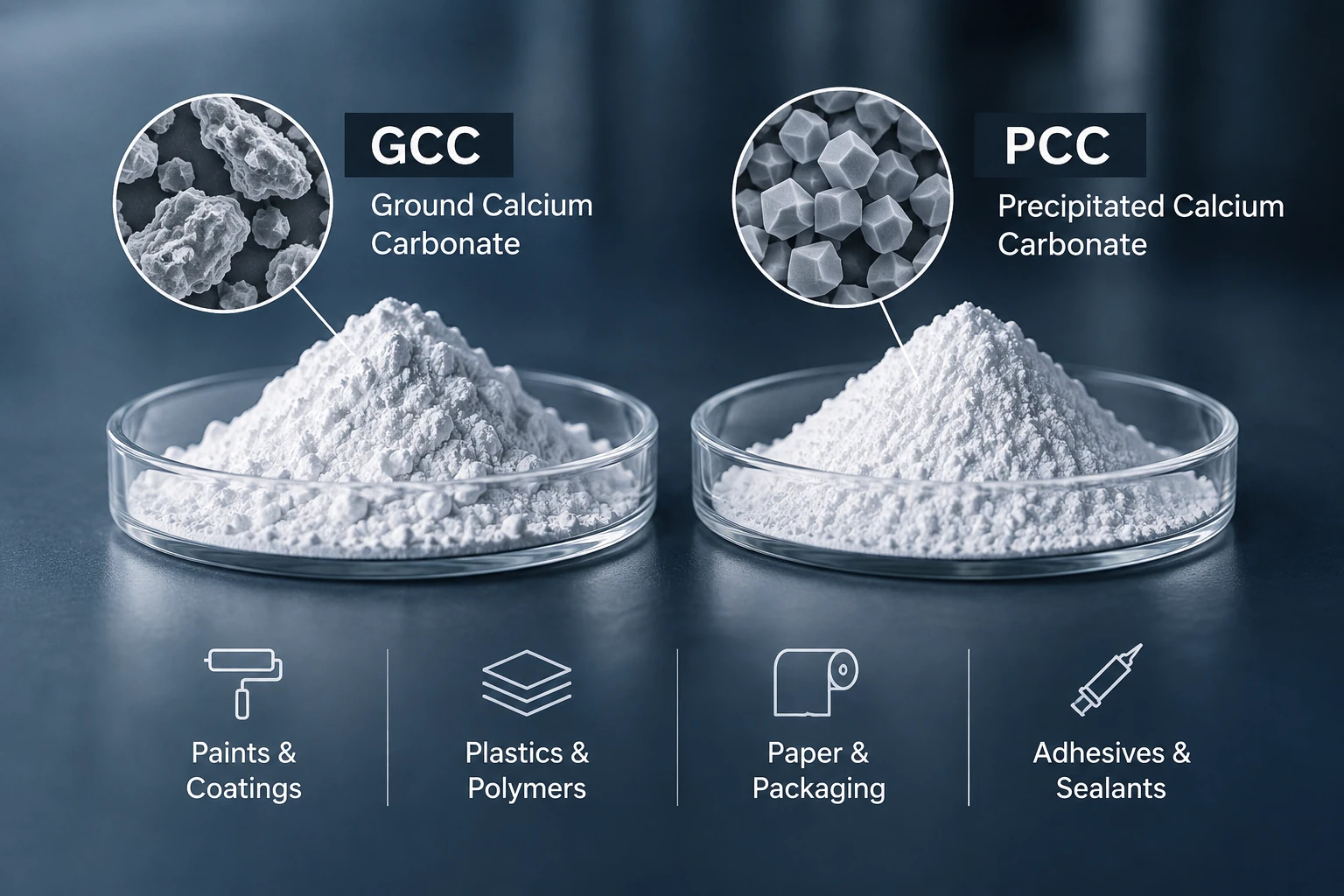
Ground calcium carbonate (GCC) is made by grinding natural carbonate rock; precipitated calcium carbonate (PCC) is made by chemical precipitation. That distinction explains the manufacturing route, not the suitability of every resulting grade. Select against your process, required properties and supplier evidence rather than treating either name as a performance specification.
For an industrial buyer, the useful comparison is a shortlist of actual grades tested in the intended formulation. This guide separates sourced process descriptions from a proposed procurement checklist. It does not recommend a particular loading, certify a material or promise substitution without reformulation.
How GCC and PCC are produced
GCC production uses physical processing: suitable natural carbonate material is ground and classified. Ask the supplier about feedstock, processing history and whether the proposed grade is supplied as dry powder or slurry, alongside the finished specification.
A conventional PCC route starts with limestone calcination to obtain lime, followed by hydration and carbonation of the resulting lime slurry. Purification and recovery steps depend on the process. This describes a conventional route, not a statement that all PCC plants use identical feedstocks, controls or equipment.
GCC versus PCC: comparison for a purchasing shortlist
| Selection factor | GCC | PCC | Evidence to request |
|---|---|---|---|
| Production | Physical grinding and classification | Chemical precipitation; conventional lime route | Manufacturing route and supply form |
| Particle morphology | Natural particles shaped by physical processing | Process conditions can influence crystal form and aggregation; verify the grade | Grade-specific microscopy and morphology description |
| Particle size distribution | Compare the full measured distribution | Compare the full measured distribution; do not assume all PCC is nanoscale | Method, dispersion conditions, percentiles and coarse residue |
| Purity and colour | Require measured grade data | Require measured grade data; synthesis is not a purity certificate | Assay, relevant impurities and stated colour method |
| Surface treatment | Check whether supplied untreated or treated | Check whether supplied untreated or treated | Treatment chemistry and compatibility evidence |
| Oil absorption | Compare a measured result | Compare a measured result, not a category stereotype | Method edition, units and agreed reference |
| Commercial fit | Obtain a current specification-matched quotation | Obtain a current specification-matched quotation | Delivered cost, minimum order, lead time and qualification needs |
Which properties should buyers compare?
Particle size distribution and morphology
A median particle size alone cannot describe a distribution. Dv50 is the median on a volume basis: half the measured particle volume lies below that diameter. Ask for the distribution basis, measurement technique, sample preparation and appropriate fine/coarse percentiles, rather than equating a median with a maximum particle size.
Use comparable dispersion conditions when reviewing laboratory reports. Ask separately whether a microscopy image describes primary particles or aggregates; do not compare an image-derived dimension with a bulk distribution without understanding what each method measures. Gallant’s existing particle-size guide provides the deeper comparison framework; this article focuses on the choice between production routes.
PCC morphology and aggregation depend on the grade and process conditions; do not infer one universal particle shape from the production route. Request representative microscopy and a description of the proposed grade instead of assuming that every PCC is needle-shaped or that every GCC has the same particle geometry.
Purity, chemical composition and surface treatment
Both labels describe calcium carbonate (CaCO3); they do not specify the full impurity profile of a commercial material. Treat calcium carbonate identity and chemical purity as separate questions. Request the assay basis and test method, relevant impurity results, moisture and batch tolerances. Ask which limits are guaranteed and which are typical. Neither a white appearance nor a production-route label should substitute for an agreed chemical specification.
The public scopes of ISO 3262-5:2023 and ISO 3262-6:2022 cover natural crystalline and precipitated calcium carbonate extenders respectively. They provide references for a standards discussion, not proof of supplier compliance. Obtain the applicable full methods and a qualified interpretation before adopting acceptance limits.
Request treatment information separately from the GCC/PCC production-route label. Ask whether the candidate is untreated or surface-treated, then request treatment chemistry, treatment level where available, moisture specification and evidence of compatibility with the actual binder or polymer.
Brightness, whiteness and oil absorption
Do not compare an unexplained brightness number with a whiteness index. ISO 2470-2 concerns D65 brightness of pulp, paper and board; ASTM E313 concerns calculated whiteness and yellowness indices under defined conditions. Ask which method, illuminant, specimen preparation and reporting basis apply to a powder or finished article.
ISO 787-5:2026 describes an oil-absorption test for pigments and extenders, including comparison with an agreed product sample. Request the method edition and units. An oil-absorption result is not a recipe for binder demand in every resin system; use it as a comparison input and check the actual formulation.
Application-specific selection
The following trial priorities are editorial recommendations, not proven GCC-versus-PCC performance rankings. Agree acceptance criteria with the formulator before comparing samples; change one controlled variable at a time and document any formulation adjustments.
Paints and coatings
The application name alone is not a sufficient basis for choosing GCC or PCC. Request particle distribution, colour method, oil absorption and treatment details. In a controlled paint trial, assess the relevant balance of dispersion, viscosity, gloss, hiding and durability rather than accepting a generic filler-benefit claim.
Plastics and polymers
Start with the polymer, conversion process and required end-use properties. Request moisture, coarse-particle control and treatment information; evaluate dispersion, process stability, surface finish and relevant mechanical tests. Qualify the whole compound, not a mineral name in isolation.
Paper and packaging
Distinguish wet-end filler from coating pigment, and define the paper or packaging requirements before selecting a candidate. Trial retention, drainage, optical properties, bulk and strength against the mill’s operating requirements. Do not assume that a change of production route will improve every sheet property.
Adhesives and sealants
Specify the binder, cure mechanism and application process before choosing a treated or untreated candidate. Compare extrusion or application behaviour, sag, cure, adhesion and storage stability as relevant. Ask for moisture test conditions rather than assuming surface treatment alone makes a grade suitable.
Compare total cost and supply conditions
Obtain quotations for a defined technical requirement and destination; this research establishes no current price or availability advantage. Compare delivered cost, packaging, transport of powder or slurry, storage, minimum order and lead time. Include qualification effort and any required formulation changes in the decision. Ask about specification-change notification and continuity of supply, rather than assuming that one route is always cheaper or locally available.
Turn the comparison into a qualification plan
Begin with the current material or an agreed reference formulation. Record its specification, source documentation and the operating problem before requesting alternatives. A useful brief might ask whether an alternative can meet an existing gloss, processing or application target; it should not start by declaring that PCC or GCC must solve the problem.
Build a side-by-side worksheet with the proposed grades, reported methods, typical values, guaranteed limits and missing information. Mark unlike measurements as not directly comparable. Ask the supplier to explain discrepancies instead of averaging incompatible numbers or silently accepting a change in test method. Keep the original data sheets with their issue dates.
Then agree a small laboratory trial followed, where justified, by a controlled production trial. Record mixing order, conditioning, equipment settings and formulation changes. Retain the reference sample and identify the tested batch. A pass against one endpoint is insufficient if another required property fails; record the trade-off and obtain technical acceptance before a purchasing decision.
Can PCC replace GCC without changing the formulation?
Do not assume a direct replacement. This research does not establish a universal substitution ratio. Define whether the proposed comparison holds mass, volume or another formulation variable constant, and ask the formulator how to interpret the result. The decision should follow the trial evidence for the specific materials, not the category labels.
Which route is best when the specification is incomplete?
Keep both candidates open while clarifying the requirements. Separate essential acceptance limits from preferences and unknowns. If a supplier cannot supply a method or tolerance, record that gap explicitly. Ask what evidence would resolve it and whether a representative sample can be evaluated; a missing value should not become an assumed advantage for either route.
Practical questions to send a supplier
- Is the proposed material GCC or PCC, and what are its supply form and treatment status?
- Which particle-size method, dispersion conditions, distribution basis and coarse-residue limits are reported?
- What are the assay, relevant impurities, moisture and optical test methods?
- Which values are typical, and which are contractual batch-release limits supported by a certificate of analysis?
- Can you provide a representative sample, current technical and safety data sheets, and a trial recommendation for our process?
- What documentation is available for the destination and end use, and what are the quoted delivery terms and change-control arrangements?
Build a specification-led RFQ
Review Gallant’s Calcium Carbonate and Precipitated Calcium Carbonate product pages, then send an RFQ with the application, binder or polymer, process, target properties, known test methods, quantity and delivery destination. If the specification is still open, describe the problem to be solved and ask which information is needed to evaluate candidates. Product relationships here identify existing catalogue families; they establish no grade, stock, certification or performance commitment.
Key takeaways
Use the production route to frame questions, then compare measured grade data.
Specify methods, tolerances and trial criteria before making substitution decisions.
Confirm technical fit and commercial conditions together; neither GCC nor PCC is universally superior.