
Technical Guides
Talc in Coatings: How Particle Size, Morphology and Mineral Purity Affect Performance
Talc should not be selected by particle size alone. Particle-size distribution, morphology, mineralogical composition, optical properties and binder demand together help determine whether a grade suits the intended coating formulation and process.
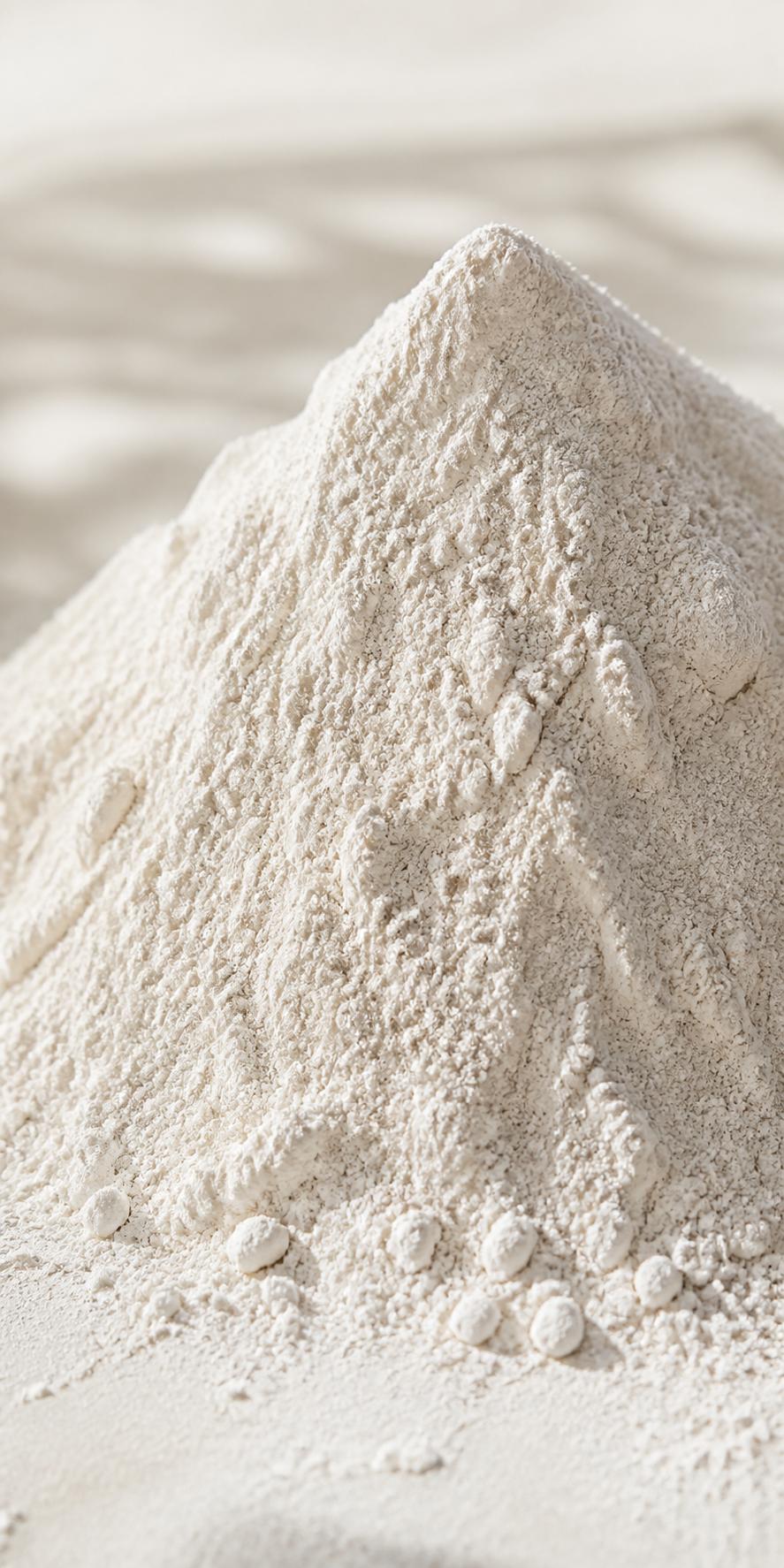
Talc is used as a functional mineral in coatings, but the name does not describe a single performance profile. Commercial grades can differ in particle-size distribution, morphology, mineralogical composition and purity, whiteness and colour, oil absorption, moisture, coarse residue and consistency.
These differences can affect how a material disperses, how the coating processes and applies, and how the film develops. For formulators, technical buyers and sourcing teams, the useful comparison is the complete grade profile against the intended coating requirements.
Key takeaways
Talc should not be selected by particle size alone. Evaluate particle-size distribution, morphology and lamellarity, mineral composition, optical properties, oil absorption and formulation compatibility together.
A finer grade is not automatically a better grade. Compare actual grade data using compatible test methods, then trial the material in the intended formulation and process before approval.
Why talc morphology matters
Talc has a characteristic lamellar, or platy, particle morphology. Particle shape and aspect ratio—the relationship between lateral dimensions and thickness—can influence packing and orientation within a coating film, rheological behaviour, and mechanical and surface characteristics.
When appropriately oriented and formulated, platy particles can create a more tortuous path through a film, increasing the distance that permeating substances must travel. This is a possible contribution to barrier behaviour, not a guarantee of corrosion resistance or impermeability from adding talc.
Final barrier performance depends on the complete coating system, including film continuity, binder properties, loading, dispersion, application and curing. Assess the finished coating against the required performance rather than inferring protection from particle shape alone.
Particle size: look beyond d50
The d50 value describes the median of a measured particle-size distribution on its stated measurement basis. It is a useful reference point, but does not describe the entire distribution. Two grades with similar d50 values can have different fine fractions or coarse tails and behave differently in a coating.
- d97 or another stated coarse-fraction parameter can help describe the upper end of the distribution. If a data sheet uses the term 'top cut', confirm how the supplier defines it; it should not automatically be interpreted as an absolute maximum particle size.
- The fine-particle fraction describes the proportion below a defined size. Keep the threshold, measurement basis and method with the result.
- Sieve residue identifies material retained under a specified test. The sieve aperture and procedure are part of the comparison.
- The complete PSD gives context to the headline values. Compare distributions obtained using compatible measurement methods.
The distribution and coarse fraction can affect surface smoothness, film appearance, texture, dispersion and processing. Consistent control of these characteristics can matter between deliveries. A finer distribution may suit one finish while a different profile suits another; finer is not universally preferable.
Particle size and morphology are not the same thing
Particle size describes dimensions and their distribution; morphology describes particle shape and structure. A reported size is interpreted through its measurement method and does not, by itself, establish lamellarity or aspect ratio.
Two talc grades with similar headline particle sizes may differ in their lamellar or aspect characteristics because of mineral source and processing. Do not use d50 as a proxy for morphology. Where particle shape is important, request relevant morphology information and assess it alongside the PSD and formulation trials.
Mineralogical composition and purity
Natural talc deposits can contain associated minerals. The mineralogical composition of a commercial grade depends on the mineral source and beneficiation or other processing. Buyers may therefore examine talc content or mineralogical purity where provided, supporting chemical composition, relevant impurities and consistency between deliveries.
MgO and SiO2 chemistry can help describe composition, while iron-bearing components and other accessory or minor mineral constituents may be relevant to colour and formulation requirements. However, oxide chemistry and mineralogical composition are related but are not interchangeable measurements. An oxide analysis alone does not prove talc mineralogical purity, because different minerals can contribute to the reported chemistry.
Where mineral composition is a selection criterion, establish what mineralogical information is available and how it was determined. Compare it with optical data and agreed consistency requirements without assuming a universal purity threshold.
Whiteness, brightness and colour
Optical characteristics can be important in white coatings, pale or pastel formulations and other colour-sensitive systems. Differences in mineral composition and processing can influence the contribution a talc grade makes to the formulation’s colour.
Whiteness, brightness and L* or other colour values are not automatically interchangeable. Compare the test method, measurement basis and reported parameter before treating two results as equivalent. Assess the grade in the actual pigment system; talc should not be assumed to provide opacity equivalent to titanium dioxide (TiO2).
Oil absorption and binder demand
Oil absorption indicates liquid demand under a defined test and is useful when comparing mineral grades. It can help frame questions about binder demand, viscosity, workable loading, wetting and dispersion, all of which contribute to formulation economics.
Neither lower nor higher oil absorption is universally preferable. The appropriate balance depends on the coating design and process. Compare values obtained using compatible methods and consider the binder and additive adjustments needed at the intended loading.
Oil absorption is not a complete prediction of behaviour in a specific resin system. Actual formulation trials remain necessary to establish viscosity, dispersion and film behaviour, and to compare the overall cost of achieving the required coating performance.
Rheology, application and film behaviour
Talc grade characteristics can influence viscosity and rheological response, suspension and settling behaviour, application characteristics, film texture, sanding or workability where relevant, and mechanical behaviour. The direction and extent of these effects are formulation-specific.
Assess these effects with the binder or resin, pigment system, PVC, loading, dispersants and other additives, dispersion process, application method, film thickness, and drying or curing conditions. Pigment volume concentration (PVC) places the mineral loading in a volume-based context; a weight-based substitution does not necessarily preserve it.
Specific density supports pigment-volume calculations, while packing density describes a separate powder-handling characteristic. Moisture and pH may also matter to formulation compatibility. Hardness and refractive index add context to the technical profile but do not independently establish sanding behaviour or optical performance.
Adding talc does not by itself promise improved adhesion, corrosion resistance, crack resistance or mechanical performance. Evaluate the required application and film properties through representative trials of the complete coating system.
A practical talc grade-selection checklist
- Compare the complete PSD, not d50 alone, using compatible measurement methods.
- Review d97, the stated top cut or another relevant coarse-fraction indicator with its definition.
- Check sieve residue where relevant, including the aperture and test procedure.
- Request morphology and lamellarity information where available; do not infer it from nominal size.
- Review mineralogical composition or purity where available, separately from oxide chemistry.
- Compare relevant chemical composition, including MgO, SiO2 and application-relevant impurities.
- Define whiteness, brightness and colour requirements with their test methods and measurement basis.
- Compare oil absorption and confirm binder demand in the intended resin system.
- Check moisture, specific density and pH where formulation-relevant; distinguish specific density from packing density.
- Specify coating chemistry, intended loading and PVC.
- Establish the dispersion process, additive requirements and required surface finish.
- Confirm packaging, commercial quantities and the consistency requirements for repeat deliveries.
- Trial the grade in the actual formulation, application and drying or curing process before approval.
Select the complete grade profile
Selecting talc for coatings requires balancing particle size, morphology, mineral composition, optical properties and formulation behaviour. A finer grade is not automatically a better grade. The appropriate choice is the one whose technical characteristics and consistency fit the required coating system and process.
Define the performance requirements, compare actual grade data using compatible test methods and confirm suitability in formulation trials. The related Talc product page below provides a starting point for reviewing the material family. For a sourcing discussion, share the coating chemistry, technical criteria, target finish, packaging and quantity requirements through the enquiry pathway below.